n.e.w.s. is a collective online platform for the analysis and development of art-related activity, drawing upon contributions from around the globe, bringing together different voices, accents and outlooks from the North, East, West and South. | Read more..


Thursday, 14. March 2013 | 01:00 (tz: Europe/Amsterdam)

Aesthetic Journalism

aestheticjournalism

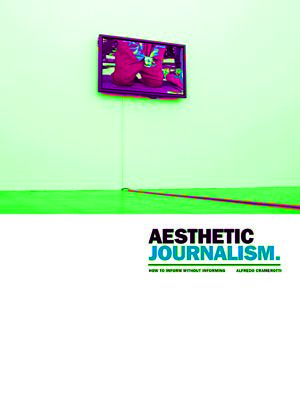
Although some readers might uphold the 20th century definition of aesthetics as concerning subjective forms or 'beauty' enforced by a group of modernist believers, others would rather engage with a more open-ended terminology. Take for example, Alfredo Cramerotti's: 'a process in which we open our sensibility to the diversity of the form of nature (and man-made) environment and convert them to tangible experience.’ So in other words, most anything that is produced nowadays could be considered aesthetics? What is perhaps most engaging is how aesthetics is taken up in journalism, in other words what Cramerotti entitles aesthetic journalism, with his eponymous book.

Cramerotti states that this concept makes possible contributing to knowledge building with a new aesthetic regime, which, in turn, questions the truth-value of a traditional regime. More importantly, it denounces that the system of representation is the same as what it represents as journalism is thought of trying to do -being the same as the facts represented. According to him it involves those artistic activities in the form of investigating social, cultural and political circumstances that take shape in the art context, rather than media.

 
Friday, 25. January 2013 | 01:00 (tz: Europe/Amsterdam)

Uselessness, Refusal, Art, and Money (encounters with David Graeber's Towards an Anthropological Theory of Value).

readingbetween_shipping

On Reading  Alone

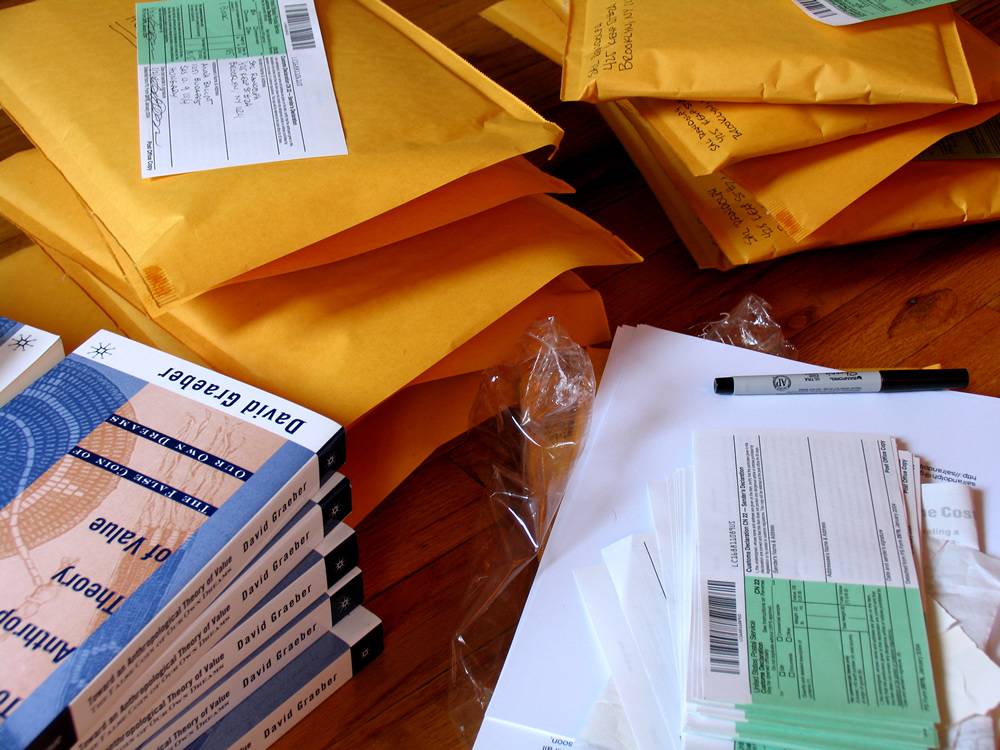
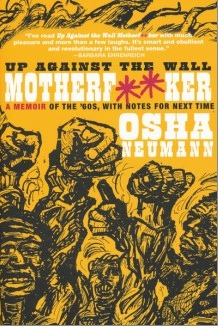
I report here on an encounter with a book, and an encounter with the problems of reading itself.  The book: David Graeber's Towards an Anthropological Theory of Value.  which I picked up following the trail of Marcel Mauss' The Gift (Graeber's book is a meditation on the differing visions of Mauss and Marx for economic life as read through the lens of anthropology).  If you operate outside of institutions, which I typically do, one book leads to another and another along solitary and idiosyncratic paths.  You often find yourself in a cloud of companionship with people you've never met, some living, some dead, some speaking native languages you have no acquaintance with.  This is thrilling, but a little surreal. As you'll see, Towards an Anthropological Theory of Value was a pleasure to wrestle with and test ideas against, but for me it also represented the moment where I turned from an ideal of books engendering books in the future, to books as a way of making relationships in the present.

 
Friday, 14. December 2012 | 01:00 (tz: Europe/Amsterdam)

After Third Text

tt1-23
tt1-23

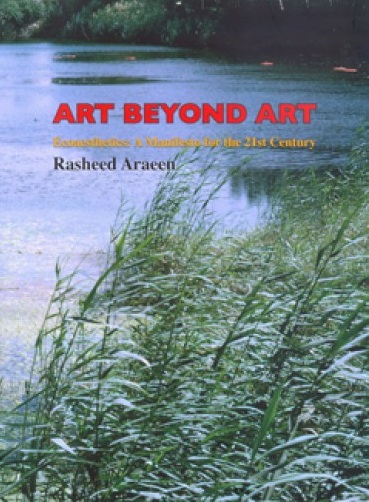
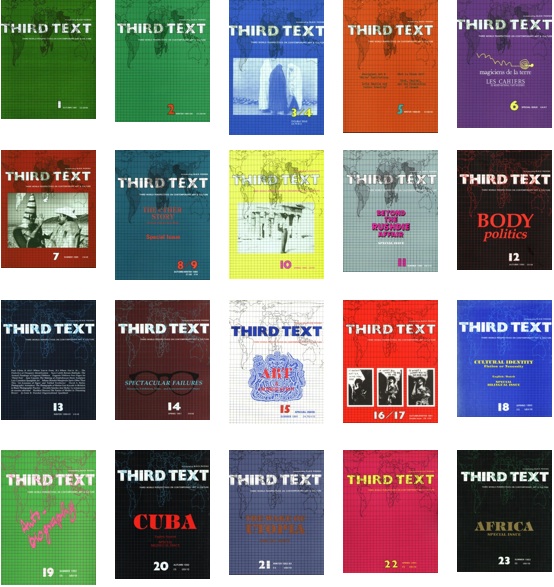
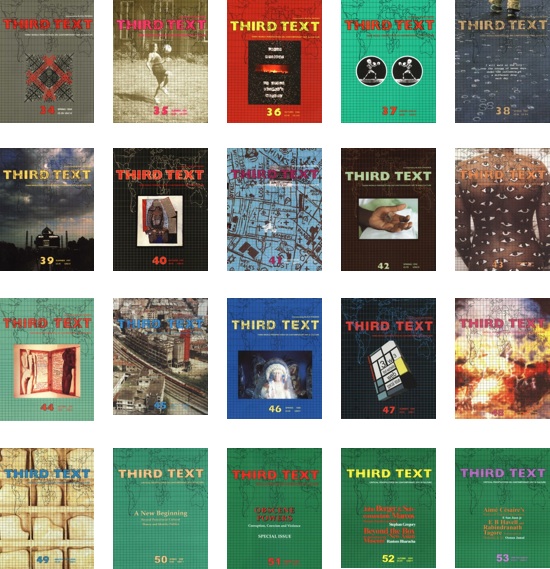
Third Text was both an art-theoretical journal, at the forefront of rethinking the conceptual institutions of art from a postcolonial perspective, and a proposition -- an artistic proposition -- of an art-theoretical journal, at the forefront of rethinking the conceptual institutions of art from a postcolonial perspective. It was both theory in practice and the practice of theory, because, from the outset, it was conceived by founding editor Rasheed Araeen, as a fully-fledged, conceptual and collective artwork -- though there was never any explicit reason for its contributors and readers to acknowledge that, since there was nothing "arty" about it, nor would it have changed in any way had it not been an artistic proposition. Yet it was precisely this 1:1 scale that it instantiated which gave it the political and conceptual wherewithal to challenge not only the biases of the mainstream artworld (and to have been an effective tool in bringing about tangible shifts in representation) but more importantly to rethink art as a whole, its mode of being and operating in the world. By operating on this 1:1 scale, it deftly eluded a certain institutional capture -- never quite what it seemed, nor where it seemed. It was an improbable discursive war machine, emerging from the political struggle against institutionalized racism in the 1970s and 80s, but an exceptionally robust one, no doubt because it proved itself capable of reinventing itself time and again, rather than falling victim to its own success. It was Rasheed Araeen's artistic proposition, but as a collective platform it was of vital importance to so many of us -- for n.e.w.s. amongst others -- both in pointing a way beyond "the altruism of collaboration" as Araeen put it, creating the kind of "world extension" required to give meaning to an uneasy global conversation and helping to imagine new ways of repurposing artistic energies with a view to transformation.

Sadly, it has become necessary to say all these things about Third Text in the past tense. Third Text has been hijacked by its Board of Trustees, who in the name of neoliberal good governance and professionalization -- but scant regard for the critical and dissident politics that were the journal's hallmark and raison d'être -- literally locked Rasheed Araeen out of the offices and usurped full editorial and administrative control.

 
Tuesday, 11. December 2012 | 01:45 (tz: Europe/Amsterdam)

Unstable by design: failure is the central idea

e

things are in a disarray;

designed to fall apart,
resistance is the privilege.

Accidents are not disruptions in the pattern, they are the norm. Every time things happen according to plan, it is a mistake. And this is not being pessimistic.

 
Saturday, 01. December 2012 | 02:00 (tz: Europe/Amsterdam)

& then you disappear

dear_art

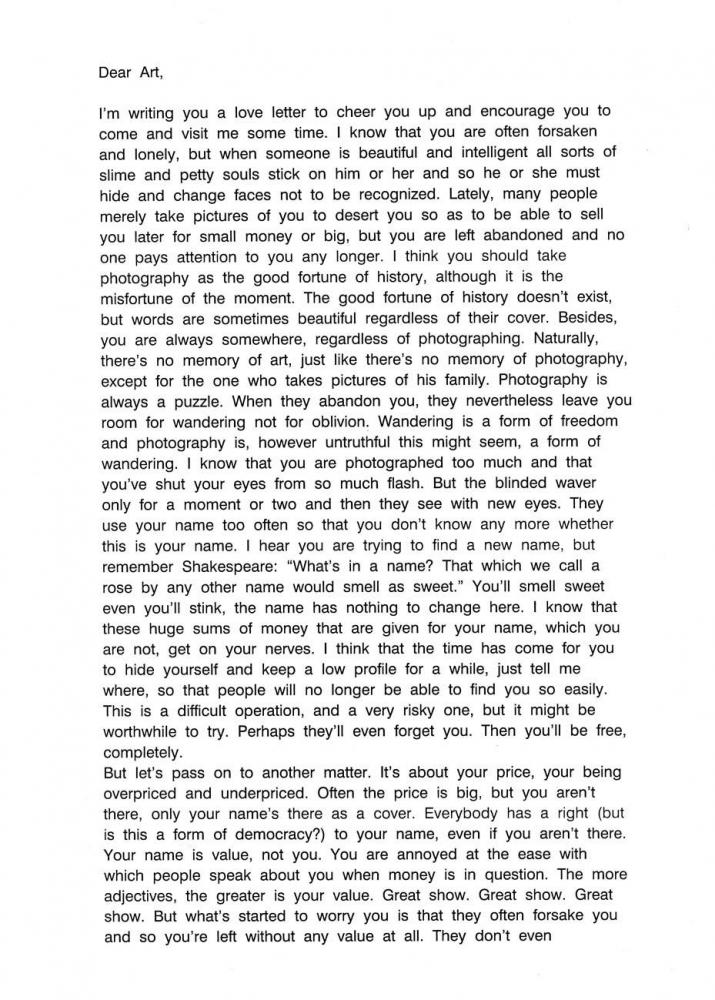
Toward the end of the 1990s, Zagreb conceptualist Mladen Stilinovic wrote an open letter to art -- not so much a love letter as some words of solace for an old friend in a pinch. The decade had been rough. Yet Stilinovic avoids the question of art's political content altogether. He commiserates about the different forms of capture to which art has increasingly fallen prey -- ideological capture, to be sure, and mercantile capture, in an attention economy where attention-getting is already emerging as the dominant form of capital accumulation. Yet to have the market pay attention at all requires submitting art to institutional capture, since to accept that art's value is merely what the market says its value is, requires accepting that art be what the institution says it is. To distinguish art from the mere real thing, as the champions of institutional theory cleverly put it, to have those objects and actions, all and sundry, appear under the auspices of art, is to submit them to a form of performative capture, through which they are performed as art. And for this reason, Stilinovic suggests, art ultimately finds itself in the grips of ontological capture -- the price exacted for it to be art at all is that it be... just art. It is not so much that art has exhausted the repertory of decoys and feints with which it has been allowed to play, as that all its ploys and sleights of hand have now been mapped out, made predictable.

 
Wednesday, 14. November 2012 | 13:00 (tz: Europe/Amsterdam)

Net art back to square one

nettitudes2

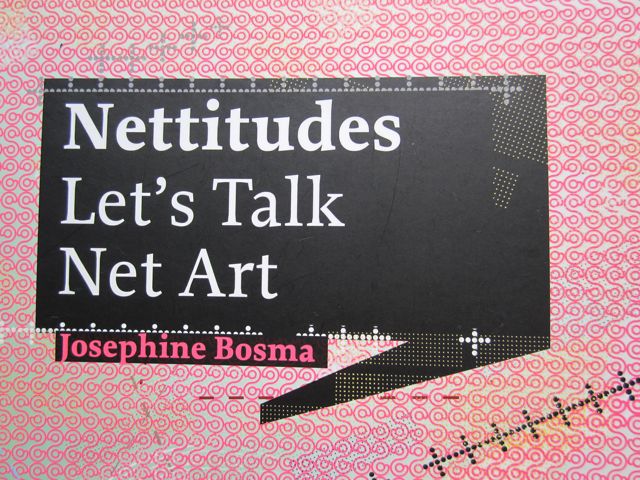
The introduction ‘Net art back to square one’ to the book Nettitudes: Let’s Talk Net Art by Josephine Boksma accurately maps out how net.art was perfectly post-media in the arts sense of being ‘post-Greenbergian’. What the author Florian Cramer means by that is articulated in his introduction, elucidating the manifold definitions of ‘media’, as well as emphasising the inhibitions within the fine art world to embrace technology. Furthermore he contextualises the necessity of this book about net.art in the larger picture because it addresses issues of ‘cultural relevance’ rather than specific forms of technological development and skill.

 
Tuesday, 06. November 2012 | 01:00 (tz: Europe/Amsterdam)

The Filter Bubble

thfilterbubble

According to the author of ‘The Filter Bubble’, Eli Pariser, technology is what the 21st century is about along with how it controls our attention. This book is specifically dedicated to what Pariser coins the ‘filter bubble’- where certain information on the internet is kept invisible and hidden which deters us from learning about things we do not know. Chapters range from how our information and data is gathered, stored, filtered and shared on the Internet to the applications of search algorithms that enable targeted marketing and advertisements. He also warns us about the future of this online world, as well as addressing the potential benefits and the creation of a civil society, whilst mapping out the history of the press and journalism in regard to freedom of speech.